Kohkum’s Royal Bannock is a fun story about a Kohkum being asked to make her famous bannock for a royal visit with Queen Elizabeth II, and Road Allowance Kitten: Full Circle is the third book in his series about a Road Allowance Métis family and their kitten.
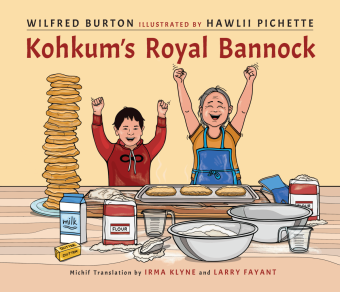
- Kohkum’s Royal Bannock
- Wilfred Burton, Hawlii Pichette (Illustrator), Irma Klyne (Translator), Larry Fayant (Translator)
- Thistledown Press
- $21.95 Hardcover, 32 pages
- ISBN: 978-1-77187-275-1
Kohkum’s Royal Bannock, brightly illustrated by Hawlii Pichette, is fiction, although it was inspired by a royal visit during Burton’s youth. He was dancing with the Riel Reelers, and they performed Métis dances for Queen Elizabeth II in Lumsden, Sask.
“The organizers had dainty crustless sandwiches, et cetera, and I flippantly said, ‘They should feed her bannock!’ From that moment, I had an idea for a children’s book where the Queen did eat bannock,” he recalls.
For many years, Burton, a lover of children’s literature, was a teacher who saw a gap in books available for kids.
“I was a teacher for many, many years, and there were no Métis children’s stories published for me to use in my classroom.”
Since beginning his writing career, he has gone a long way toward rectifying this situation, having published more than 30 children’s books to date.
In contrast to the light fun of Kohkum’s Royal Bannock, Road Allowance Kitten: Full Circle deals with the heavy topic of tuberculosis.

When the publisher of his series asked him for a third instalment, Burton says he wanted to explore other issues Metis encountered during that era of the Road Allowance People.
He chose something that was a part of his family history. “This hits home for me because my mother also had tuberculosis,” he says. “This may be the first children’s picture book to bring that to light.”
Christina Johns, the illustrator of Road Allowance Kitten: Full Circle, says she never sought out being an illustrator for children’s books.
“I’ve always been a creative person – crafting, painting, taking photos, and making art out of natural or found materials like feathers, stones, and wood. But I never actually considered myself an ‘artist.’”

- Road Allowance Kitten
- Wilfred Burton, Christina Johns
- Gabriel Dumont Institute Press
- $17.50 Paperback, 48 pages
- ISBN: 978-1-988011-37-0
Her friendship with Burton led her down this path. “Our bond was built over laughter, good stories shared over lunch, and a mutual love of Indigenous literature. Wilfred recognized my artistic talent and invited me more than once to illustrate his stories. Each time, I said no.”
Eventually, she did say yes, and she’s illustrated all three books in the Road Allowance Kitten series.
“My illustrations in this final book are rich with emotion and cultural resonance. I wanted to show tenderness, resilience, and belonging in each image,” she says.
“I wanted each page to carry a feeling of healing.”
Johns is a proud Métis woman, but that wasn’t always the case. “My heritage is at the heart of my work – but it took time for me to connect to it. I didn’t grow up with a strong understanding of my identity.”
She has also felt the gap in Indigenous stories.

“Growing up, the books we read either misrepresented Indigenous people or left us out entirely. That gap made me realize how important it is for young readers to see our truths, our beauty, and our lived realities reflected with care and respect. When I illustrate, I try to do that – with heart and honesty.”
Both Kohkum’s Royal Bannock and Road Allowance Kitten: Full Circle are written in English by Wilfred Burton and translated into Michif by Irma Klyne and Larry Fayant.
“Michif is an endangered language. My mother was a Michif speaker until she went to school, but I didn’t learn it. I feel it is important to preserve the language and to have it available for others to learn from,” Burton says.
The two books have very different energies. “Road Allowance Kitten is a more serious book – historical fiction that is often used as a teaching tool in schools, institutions, and in family homes where the culture wasn’t necessarily known or celebrated until now,” says Burton.
“Kohkum’s Royal Bannock is just for fun, to have a laugh or two. It was fun writing it with somewhat ridiculous and exaggerated scenes. Sometimes it is good to just read something fun and light.
“So many of our Indigenous stories are based on the trauma we experienced historically. They are heavy and need discussion to understand. This one is for fun.”